 Champion Standard Podcast | Crimson Chaos in Columbia
Posted on: October 19, 2025
Champion Standard Podcast | Crimson Chaos in Columbia
Posted on: October 19, 2025
Crimson Chaos in Columbia: The Sooners Find Their Rhythm Again
Introduction: The Standard Restored
“Bud Wilkinson invented winning,” the Champion Standard intro echoed — and for the first time in weeks, it felt like Oklahoma football was living it again.
Coming off the humbling 23–6 loss in Dallas, the Sooners walked into Williams-Brice Stadium and put on a statement performance: a 26–7 dismantling of South Carolina that blended suffocating defense, a balanced offense, and a physicality that had been missing since Week 1.
“This was the reset,” Rob said. “Get back to being who we are — play defense, run the ball, control the line of scrimmage. That’s Oklahoma football.”
The message was clear throughout the episode: this was the game where Oklahoma found its complementary rhythm.
Section I: Defense Turns Chaos Into Art
Before the offense even found its footing, the defense wrote the script.
The Sooners didn’t allow a single third-down conversion until the fourth quarter, forcing South Carolina into a staggering 0-for-10 start. By game’s end, the stat sheet told the story:
- 13 tackles for loss
- 6 sacks
- 2 interceptions
- 1 safety
- And just 224 total yards allowed
“That’s suffocating football,” Brad said. “That’s chaos.”
Quarterback Lanorris Sellers, a dual-threat phenom who had bullied defenses all season, spent the afternoon running for his life.
“We turned Sellers into a backyard quarterback,” Rob said. “Everything they did was broken-play survival. Hero Ball. Panic Ball.”
Even as backups entered in the fourth quarter, the aggression never waned. Marcus Strong punctuated the day with a safety that made it 26–7, sending Oklahoma’s sideline into celebration.
“You’ve got your twos and threes in.. fours in!, and they’re still living in the backfield,” Brad said. “Nothing explains it but Crimson Chaos.”
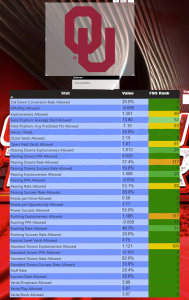
According to Champion Standard’s in-house data
“Third-Down Conversion Rate Allowed: 25%. That’s second nationally.
Havoc Rate: 28.6%. – 1stYards Per Play Allowed: 3.87 yards – 1st
O-Line Yards Allowed: No. 4 nationally.”
Brad nodded. “You’re not beating this defense unless you play perfect.”
The tape told the same story. Every drive was pressure, disguise, and discipline.
“Every week, they make you drive the hard way,” Rob said. “No freebies. You have to earn every inch against this group.”
Section II: Kendall Daniels the Positionless Monster
If the defense has a face, it’s Kendal Daniels — part safety, part linebacker, part missile.
“One snap he’s blitzing off the edge, the next he’s covering a slot fade 30 yards downfield,” Brad said. “He’s everywhere.”
Peyton Bowen joined him in Venables’ evolving “Cheetah package,” creating what Brad called “the most positionless defense in college football.”
“When Brent’s got both those guys moving around, it’s hell for an OC,” Brad said. “They can disguise pressure, spin coverage, or fill the run — all from the same look.”
Venables’ defense didn’t just win physically — it confused, disguised, and smothered.
“You can’t read it,” Rob added. “One play looks like Cover 1, the next it rolls to trap coverage. You blink and it’s third-and-14.”
Section III: A Run Game Reborn
After weeks of criticism, Oklahoma finally played like a team committed to the ground.
“This was the identity game,” Rob said. “Ten running-back carries in the first twenty plays — that’s the highest all season.”
| The Script: First 20 plays distribution. | |||||
|---|---|---|---|---|---|
| Game | Running Backs | RB YPC | Qb | WR | Passes |
| South Carolina | 10 | 7.3 | 1 | 0 | 9 |
| Texas | 4 | 1.25 | 2 | 1 | 13 |
| Kent State | 9 | 6 | 2 | 9 | |
| Auburn | 5 | 2 | 4 | 1 | 10 |
| Temple | 6 | 2.5 | 1 | 1 | 12 |
| Michigan | 3 | 1 | 4 | 13 | |
| Illinois State | 5 | 2.8 | 3 | 12 | |
| Total | 42 | 2.6 | 17 | 3 | 78 |
| 35% | 14% | 65% | |||
The numbers supported him. Through the scripted first twenty snaps, Oklahoma averaged 7.3 yards per carry, the best mark since Week 1.
The approach was simple: duo and inside zone — over and over.
“You don’t need 15 concepts,” Rob said. “You need two you can hang your hat on.”
Below is the updated Run Concept Data Table from the South Carolina tape:
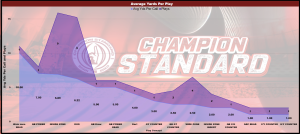
| Concept | Calls | Yards per Carry | Explosive Plays (10+) |
|---|---|---|---|
| Inside Zone | 9 | 6.8 | 2 |
| Duo | 9 | 6.2 | 2 |
| Wide Zone Read | 1 | 10.0 | 1 |
| QB Power | 1 | 7.0 | — |
| GT Counter | 2 | 2.5 | — |
“Eighteen calls between inside zone and duo,” Rob noted. “That’s 50 percent of the run sheet. This was a tendency breaking game.”
The film reinforced it. The line played with leverage, pad level, and patience.
When the offense was backed up, they didn’t hunt for low-percentage chunk plays. They leaned on the offensive line to start the drive and set the tone. That’s a major shift from the first five games — and it’s why we believe this downhill mindset is here to stay.
“Nwaiwu and Fasusi were blowing guys off the ball,” Brad said. “You could feel the line of scrimmage start to move.”
And for the first time all season, Oklahoma’s best offensive play wasn’t a pass — it was Xavier Robinson’s 25-yard duo burst.
“That was our moment,” Rob said. “First time this year, our top play was a running play. That’s balance.”
Section IV: The Arbuckle Adjustment — Breaking His Own Tendencies
The show’s most animated segment came when Rob detailed the offensive overhaul from coordinator Ben Arbuckle.
“This was a total reboot,” he said. “No pistol. 4 empty calls. No QB run crutch. He changed everything.”
Over the first six games, Oklahoma averaged 8 empty-formation snaps per game and Pistol formation 5 snaps per game.
Against South Carolina?
Empty = 4 snaps. QB runs = 1 call. Pistol = 0
“He simplified the menu and trusted his backs.” Brad said.
Arbuckle replaced gadgetry with geometry — motioning tight ends across the formation, adding split-flow looks, and using RPO tags only when the box count demanded it.
“Instead of trying to outsmart people, he went and hit them in the mouth,” Rob said. “It was beautiful.”
The result: a 50-50 run-pass split on the opening script, and a control of tempo that mirrored Oklahoma’s classic 2008 DNA.
“You could feel the rhythm again,” Brad said. “Every call set up the next one.”
Section V: Mateer — Managing, Not Forcing
Quarterback John Mateer wasn’t asked to be Superman. He was asked to be steady — and he delivered.
His stat line wasn’t glamorous: 14-of-21 for 150 yards, 1 TD, 0 INTs.
“His hand still isn’t right,” Brad said. “You could tell by the lack of deep balls — nothing over 20 yards. But he managed it perfectly.”
Brad echoed the sentiment:
“This is what a mature QB game looks like. No panic, no hero ball, just manage the game, move the chains, and let the run game churn.”
Mateer’s usage dropped from 14 rush attempts vs Texas to just 7 in Columbia, and there was a 33-play gap between designed QB runs. (8th carry was a sack)
“That’s how it’s supposed to be,” Rob said. “Let him save his legs for the fourth quarter, not the first drive.”
The offense thrived because the QB stopped being the offense.
Section VI: Offensive Line Redemption
Perhaps the most encouraging film note came from the trenches.
“Everything looked cleaner,” Rob said. “Pad level, combo climbs, the whole deal.”
The Sooners averaged 5.1 yards per carry on running-back attempts.
Left tackle Fasusi graded out as the team’s highest-rated blocker in the internal Trench Index, while guard Wiwu anchored a line that “finally moved people off the ball.”
Even Ozeata, whose miscues had drawn criticism a week prior, earned praise for what Rob called “the most violent rep of the season.”
“He blocked three guys in one play,” Rob said. “Literally. A chip, a redirect, then finishes the backside pursuit.”
The key was simplicity. Fewer protections, clearer rules.
“They didn’t try to outscheme South Carolina,” Brad said. “They just came downhill and said, ‘Stop us.’”
Section VII: Special Teams — The Weak Link
For all the dominance elsewhere, one issue lingered.
“The punt coverage was rough again,” Brad noted. “You can’t keep giving away hidden yards.”
Still, kicker Sandel remained perfect on the year, drilling field goals from 41 and 48 yards.
Section IX: The Road Ahead — Lane Kiffin Awaits
With South Carolina buried, the conversation shifted to the looming test: Ole Miss.
“Now it gets real,” Rob said. “Lane Kiffin’s coming off a loss, and he’s pissed.”
The Sooners will host the Rebels in an 11 a.m. kickoff, a scheduling quirk that both hosts ridiculed.
“Why are we playing the biggest chess match of the year at breakfast?” Brad joked.
But the matchup is pure intrigue:
- Kiffin’s offense ranks No. 4 in the SEC in scoring with 37.4 ppg
- QB Trinidad Chambliss has accounted for 1,872 total yards and 13 TDs
“This is the real measuring stick,” Rob said. “Venables vs Kiffin — chaos vs tempo.”
Brad agreed, predicting fireworks.
“This might be the first time our defense has to hold someone under 30 just to win. You’re not beating Ole Miss 17-10.”
Depth in the secondary could determine the outcome.
“If Gentry’s still limited and Dolby’s out, that’s dangerous,” Rob warned. “Chambliss can pick apart zone coverage.”
Still, the hosts expressed optimism.
“If we steal two of the next three — Ole Miss, Tennessee, Alabama — we’re in playoff contention,” Brad said.
“Win your home games, split the road ones,” Brad replied. “That’s championship November.”
Final Word: Rhythm, Revenge, and the Return of the Standard
“This was Oklahoma getting back to who we are.
Run the damn ball. Play defense. Control the game. That’s the Standard.”
“The SEC doesn’t hand you respect,” Brad said. “You earn it on the road, in the trenches. And Saturday, we earned it.”
“This is the version of Oklahoma that can make noise in this league,” Rob said. “This is Crimson Chaos.”
And just like that, the Champion Standard was back — balanced, brutal, and believing again.
Boomer.
Trench Warfare will be Wednesday night for a full breakdown on the line play with Jy and Alex!
Thanks for reading!
Rob