 Champion Standard Podcast | Trench Warfare: Oklahoma’s Offense Found Its Identity in Columbia
Posted on: October 22, 2025
Champion Standard Podcast | Trench Warfare: Oklahoma’s Offense Found Its Identity in Columbia
Posted on: October 22, 2025
Rob, Alex and JY got together tonight to break down some film from the South Carolina game.
Trench Warfare: Run Game Identity Established
-Rob, Alex, and JY
Section I: “Back to Who We Are”
Oklahoma didn’t just win in Columbia — it rediscovered its football standard.
For the first time all season, the Sooners played with purpose, patience, and power. “This wasn’t finesse football,” Rob said. “It was trench football. You could feel it from the first snap.”
Ben Arbuckle’s offense leaned on Duo and Inside Zone like they were gospel — 68% of all rush attempts came from those two concepts. The result? 5.1 yards per carry and 7.3 yards per play on scripted drives.
“Execution, execution, execution,” JY said. “When you know what you’re good at, stop trying to reinvent the wheel. They ran Duo nine times, and every single one looked cleaner than the last.”
Section II: Duo and the Death of Cute Football
The film didn’t lie — this was simplicity at its finest.
“You can see the comfort,” Alex said. “No more trying to dress everything up with window dressing or fake motion. Just call Duo, fire off the ball, and move people.”
Oklahoma averaged 6.22 yards per carry on Duo. But the key wasn’t the stat line; it was the identity behind it.
“Anytime you can let a group of offensive linemen not have to think a whole lot,” JY said, “they’ll move people. That’s the best thing Arbuckle’s done all year — he’s stopped making these guys think like engineers.”
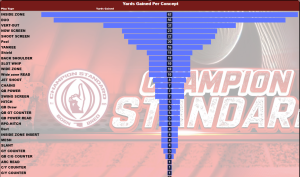
The numbers from the Champion Standard breakdown tell the story:
- Duo: 9 plays, 6.22 YPC
- Inside Zone: 9 plays, 6.89 YPC
- QB Power: 1 play, 7.0 YPC
- Wide Zone: 4 plays, 2.5 YPC
“This game wasn’t about scheme,” Alex added. “It was about moving bodies! We got downhill, and the defense broke.”
Section III: Heath Ozaeta — Technique Over Hype
Every film room has that one moment where a player’s story flips — where potential starts to look like performance. For Oklahoma’s left guard Heath Ozaeta, that moment came on the first play of the South Carolina game.
“He made the biggest improvement… out of anybody,” JY said. “How smooth he was compared to last week — that’s a big-time improvement on the very first play of the game.”
“Be Alert for Games! And Ozeata had great awareness here.” Rob said.
The clip they paused on showed Ozaeta patiently passing off a 4i-tech defensive lineman before climbing perfectly to seal the linebacker. He’s developing clean technique.
“He’s patient. He understands through the teaching that somebody’s got to have that inside gap.” Alex said.
The transformation, they agreed, was mental as much as physical. “The battle for Ozaeta is between his ears right now — getting his body to do what his mind knows it should.” JY said.
“Blue-collar kid… tough, gritty… going to turn himself into a player out of sheer will.” JY said.
For all the talk about five-star flash and transfer-portal hype, the Sooners’ offensive turnaround in Columbia had more to do with Ozaeta’s kind of football — unglamorous, technical, earned. As the Trench Warfare crew put it bluntly, when the line wins, everything else falls into place.
In a week defined by downhill attitude, Heath Ozaeta became the embodiment of Oklahoma’s new standard — not hype, just hard coaching, hard work, and harder contact.”
Section IV: The Young Guns — Fasusi and Simmons Take Control
“Fasusi’s got real juice,” Rob said, pointing to a six-yard Duo where he washed down the defensive tackle and then climbed to the linebacker. “You can see the violence coming on.”
“He’s learning pad level,” JY said. “He’s been a waist-bender at times, but he’s improving. Once he learns to strike through the hips, he’s going to maul people.”
“Those guys looked like they were having fun,” Alex said. “That’s when you know you’re building something.”
Section V: The Thunder Duo — X-Man and Blaylock
Running back Tory Blaylock played like a veteran. “He’s smooth,” Alex said. “No wasted motion, no dancing. He’s one cut and go.”
JY agreed: “He doesn’t get enough credit for how decisive he is. That’s why Duo works for him — he hits it vertical.”
Then there was Xavier Robinson, affectionately called “X-Man.”
“He’s a 240-pound freight train,” JY said. “He’s our baby Eddie Lacy. Just let him run through faces.”
The data backed it up — Robinson had the biggest play of the day with this 25 yard carry and converted all short-yardage situations.
“You could build a whole offense around that kid,” Rob said. “Let him hammer people, and suddenly the play-action opens up. That’s how you make life easy for your QB.”
Section VII: Arbuckle ate “Thunder Chicken” in coverage calls.
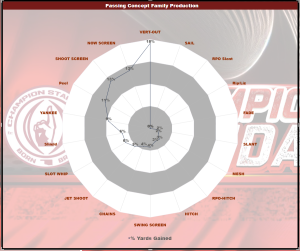
Ben Arbuckle’s growth as a play-caller showed up in one of the most subtle ways in generating easy yards in our passing game — how he dissected South Carolina’s corner-safety combo coverage out of stack formations.
For three quarters, the Gamecocks had their corner playing the point and safety taking the top hat, a structure meant to squeeze the outer routes and protect the sideline. But Arbuckle saw the weakness instantly. “He knew exactly what they were doing,” Rob said. “He saw the DB calls on tape or on field, knew the safety was chasing leverage, and just kept attacking it.”
“Vert-Out led the way,” Rob said, referencing the 18% of total passing yardage coming from that family. “Mateer took the easy speed outs.”
The short game was equally crucial. “Now Screen and Shoot Screen gave us cheap yards,” JY said. “You get five, six, eight yards without stress. That’s a coordinator doing his QB a favor.”
The Sooners repeatedly motioned across the formation, creating stack looks that forced South Carolina to declare coverage.
“If you know the safety’s got the top hat,” Rob explained, “then you just run a slot whip or slant— easy yards every time!”
Mateer executed it perfectly, driving slants and return routes into the soft voids for quick-hitting gains. “He just kept calling it,” Rob added.
“If they’re not going to adjust, you make them pay.”
Section VIII: The Film Doesn’t Lie — Physical Football Wins
By the end of the film session, all three hosts agreed — Oklahoma imposed its will.
“This is who we are,” JY said. “You line up, move people, and make defenders quit.”
Alex added, “You can’t finesse your way through the SEC. This was our statement that we’re done trying to be cute.”
Alex summed it up: “This game wasn’t about yards — it was about tone. Arbuckle told his guys, ‘We’re going to play trench football.’ And they did.”
Section IX: What’s Next for Oklahoma’s Offense
When the Trench Warfare crew turned the page toward Ole Miss, each host had a clear vision for the next step in Oklahoma’s offensive evolution.
JY kept it simple: “More physicality.” He emphasized that everything — technique, timing, and communication — flows from that foundation. “It starts and finishes with physicality,” he said. “You don’t want to be the reason your backs can’t do something spectacular. You’ve got special athletes at Oklahoma — move people so they can shine.”
Alex focused on the aerial complement. He wants the Sooners’ downhill dominance to start paying off through play-action shots. “Now that you can run the ball, it’s time to pop some deep plays,” he said. “Give Gibson chances downfield, hit Sategna and Burks on verticals, and attack the hash marks with Kanak. If they can tie the ground game to the deep ball, this offense becomes lethal.”
Rob turned to control. He wants Oklahoma to string together long, punishing drives that demoralize opponents and protect the defense. “I’d love to see six- or seven-minute drives back-to-back,” he said. “That’s how you take over a quarter. You help your defense, you control tempo, you make teams play your game and keep opposing offenses off the field.”
Together, their message was clear — Oklahoma has found its identity. Now it’s time to WEAPONIZE the run game: stay physical, stretch the field, and own the clock!
Thank you for reading!
BOOMER!
Rob