 Champion Standard Podcast | Oklahoma Broke Auburn
Posted on: September 21, 2025
Champion Standard Podcast | Oklahoma Broke Auburn
Posted on: September 21, 2025
Continuing with our plan to share some content that a couple of members of our community have been creating for close to a year now!
I am happy to be able to announce that TFB supports The Champion Standard Podcast!
Our guys @soonerbrad and @Birddawg have been pumping out some high-quality podcasts that talk about Xs and Os, hot topics, and OU football talk in general. This podcast represents the views and opinions of Rob and Brad and TFB is not part of their operation, but we do endorse it wholeheartedly!
Each time a new podcast drops I will post it here for the community. Give the guys a listen, sub to their YouTube channel, and include their pods on your mobile devices!
Opening and Atmosphere
Oklahoma’s win over Auburn felt less like a shootout than a stress test the Sooners were built to pass. The podcast opens on the environment, a legitimately disruptive night in Norman that showed up on the ledger with six false starts, two delays of game, and multiple holding calls on Auburn. The crowd and cadence combined to tilt early downs. From there, the conversation centers on a defense that created constant friction and a coaching staff that kept tightening the screws as the game matured.
Defensive Front and Pass Rush
The defensive front is the headline. Depending on the data provider, Oklahoma finished with nine (SIS) to eleven sacks (PFF) and added 14 tackles for loss. Most important, eight different players recorded at least one sack, a distribution that underscores depth and a plan that confuses protection rules. Pressure arrived from the edges, from the interior, and from the second level, and it arrived with post snap uncertainty. The show stresses the difference between blitzing more and blitzing smarter. The payoff was predictable. Auburn lived in long yardage and threw short of the sticks on too many third downs.
Coverage Adjustments and Explosive Control
The coverage pivot mattered just as much as the rush. Early, Oklahoma played more man behind pressure and paid for it against Cam Coleman, whose gravity shaped Brent Venables’ call sheet. The second half adjustment to more Cover 6, traded volatility for control by erasing most explosive passes while keeping eyes on crossers. That choice invited underneath completions but squeezed Auburn’s drive math. The Tigers could move five yards at a time, not twenty, which gave the Sooners defense more opportunity to find negative plays. As the hosts put it, the staff traded volatility for control.
Run Game Reality and Offensive Shape
Offensively, the episode is candid about the run game. Between a banged up line and a legitimate Auburn front, Oklahoma’s rushing output sagged as the hosts reference roughly thirty two yards on twenty six carries. The staff leaned into what was available, pass protection that held up well enough with chips and six man looks, and quarterbacks who found chunk gains against stressed zones. Standard down pass rate ticked up relative to baseline, and John Mateer produced eleven explosive completions to four different receivers. The panel’s verdict on the quarterback discussion is measured. Jackson Arnold was composed given the punishment, but the edge goes to Mateer for explosives. The broader takeaway is that Oklahoma won without its preferred offensive shape. If the Sooners reclaim easy yards on the ground, the ceiling moves.
The Substitution Sequence
There is a segment on the much discussed substitution wrinkle, what the show jokingly calls the deception play. Brad notes the conference chatter that followed about deception and substitution mechanics but counter that the receiver reported in and officials acknowledged him. Deception, sequencing, and tempo are part of the sport’s fabric. However that debate lands in public, the panel frames it as a smart call at a high leverage moment rather than the crux of the win.
What Travels and What Is Teachable
The pod places this game inside an emerging identity. The defense profiles as a traveling trait. Negative EPA allowed on dropbacks, a rising havoc rate fueled by sacks, batted balls, and forced throwaways, and elite yards per play prevention. It is happening even while takeaway luck lags. If takeaways normalize and short yardage improves, Oklahoma moves from hard to beat to able to close out November. The crowd piece is not treated as fluff. It is an input that can be standardized. The atmosphere that rattled Auburn is something the hosts want every week, and they even lobby for a fourth quarter song that lands with real punch.
Areas to Improve
The run game remains a focus area. The staff wants better line credited yards before contact, cleaner double to backer timing against slanting fronts, and a short yardage identity that does not rely on gadget calls. On defense, the notes are about detail. Screen control, quarterback draw fits, and a few tackling angles in quarters can be cleaned up before the next stretch of the schedule. None of it feels existential. It reads like tuning on a system that already works.
Schedule Context and Roster Depth
Auburn is framed as a quality conference opponent with NFL caliber linemen, which makes this a resume win that should age well. Tennessee and Alabama present different stylistic tests, with vertical threats and quarterbacks willing to push the ball, but the panel does not see mismatches. The staff credits the ability of Brent Venables to tailor week to week and the depth up front, with Jayden Jackson, R Mason Thomas, David Stone, and others rotating without drop off, as reasons Oklahoma can keep games on its terms.
Special Teams and Field Position
The show gives real credit to special teams. Oklahoma shut down Auburn in the return game and kept the Tigers behind the field position line all night. Tate Sandell was solid on placements and kickoffs, giving the Sooners clean operation and steady points. Grace Miller flipped the field with five punts for a 55 yard average, an outstanding night that stacked hidden yards on top of the defensive havoc. Kick coverage squeezed lanes, punt coverage finished clean, and there were no back breaking returns. Hidden yards favored the Sooners, which shortened the field for the offense and lengthened it for Auburn.
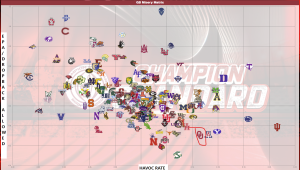
The Champion Standard QB Misery Matrix is a two-axis snapshot of how painful you make life for opposing quarterbacks. The x-axis is Havoc Rate, the share of dropbacks that end in a disruptive event like a sack, hurry, batted ball, forced fumble, interception, or pass breakup. The y-axis is EPA per dropback allowed, a drive-weighted efficiency metric where lower is better for the defense. Read it by quadrants: bottom-right is maximum misery (lots of disruption and negative efficiency), top-right is feast or famine, bottom-left is sound but unsplashy, and top-left is comfortable QBs.
Oklahoma sits in the bottom-right cluster with roughly mid-teens Havoc and negative EPA allowed, which means you are both stressing protection and erasing efficiency. That tracks with what we saw vs Auburn: eight different Sooners recorded sacks, pressure arrived from multiple levels, and explosive passes were largely denied. In football terms, you are manipulating protection IDs pressures while keeping the roof intact with by being balanced, so even when the ball comes out, it is often a throw with no profit. If OU stays in this quadrant and keeps the explosives capped, that profile travels to November and BEYOND!
Closing View
In the end, Oklahoma weaponized environment, brought the heat, protected the roof, and accepted shorter offensive possessions on a night the defense could carry the load. Special teams shut down Auburn’s return game and kept the field tilted. If the easy button returns to the ground attack, the Sooners November math looks simple. Defense that travels, offense that closes, and a path that no longer requires perfection to stay in the conference and playoff chase.
Tailgate
Y’all continue to show out. From the first pork-butt sandwich to the last high five on the way into the stadium, our tailgate is beginning to feel like family. The jokes, the smiles, the new faces, the old friends—every bit of it turned the Palace on the Prairie into an all-day heater.
Huge love to everyone who continue to join in!
Just want to say “Boomer and Thank you!
We’ll keep bringing the film, the fun, and the food. Let’s keep growing this party!
See you at the next one.
Boomer!
-Rob
Check out additional resources at www.championstandard.com
Final Note
I’m a numbers guy. It’s my career. I’ll be tracking everything I can. But after watching this game vs Auburn, one thing is clear: advanced or basic, offensive stats do not mean a thing until they face Oklahoma’s defense. In 2025, OU’s defense decides who is and who isn’t a good offense. Period.