 Champion Standard Podcast | The night OU found answers
Posted on: September 7, 2025
Champion Standard Podcast | The night OU found answers
Posted on: September 7, 2025
Continuing with our plan to share some content that a couple of members of our community have been creating for close to a year now!
I am happy to be able to announce that TFB supports The Champion Standard Podcast!
Our guys @soonerbrad and @Birddawg have been pumping out some high-quality podcasts that talk about Xs and Os, hot topics, and OU football talk in general. This podcast represents the views and opinions of Rob and Brad and TFB is not part of their operation, but we do endorse it wholeheartedly!
Each time a new podcast drops I will post it here for the community. Give the guys a listen, sub to their YouTube channel, and include their pods on your mobile devices!
Oklahoma 24, Michigan 13: The night OU found answers — and an audience — on the field and on the trail
On a prime-time stage, Oklahoma didn’t deliver a fireworks show so much as a professional win: long possessions when it mattered, explosive answers when needed, and a defense that kept Michigan’s freshman quarterback uncomfortable without emptying the pressure playbook. It played like a Brent Venables team that knows who it is in September — and like a Ben Arbuckle offense that’s discovering just how many different doors it can open in a week-to-week game plan.
This is how the Champion Standard crew — with TFB’s Charlie riding shotgun — saw it, with a heavy lens on recruiting buzz, the verticals package, and a handful of stats that actually matter.
Recruiting Notebook: a banner night (and a busy one)
Charlie’s read from the weekend was straightforward: OU staged the kind of visit weekend recruiting staffs dream about — seamless logistics, a charged stadium, and just enough on-field variety to let different position groups imagine a role. He checked with several prospects and sources after the game; the common refrain was “electric atmosphere,” with much of OU’s current attention clustered around 2026 commitments and targets while the 2027 board quietly gathered momentum. Names to know: 2027 WR Demare Dezeurn
and QB Peyton Houston, with early signs OU is positioned well with both.
And on the trail? Keep doing exactly what they just did. Make the building feel like family, make the day feel like Disney, and keep stacking Saturdays where different position groups can see themselves in the plan. The scoreboard matters, but so does the storyboard — and OU told a compelling one this weekend.
The headcount was daunting — roughly 80 recruits on campus — and yet the feedback loop had almost no complaints about access or attention. Credit here was pointed and specific: OU’s recruiting events coordinator, earned plaudits from both hosts and visiting families for running a seamless day that “felt like Disney,” as one 2026 commit’s family put it. That “genuine” in-person experience matters when your board spans two cycles and a half dozen states.
The 2027 class, in particular, “is going to get rolling,” Charlie said — with an eye on how Auburn weekend could accelerate timelines. If OU stacks game-day experiences like this one, expect more early traction than we typically see in Norman at this point on the calendar.
Charlie’s Impact Notes
Charlie’s game reaction landed on three chords and a hook: physicality, focus, and a grown-man finish. He framed it as Venables’ biggest stage to date and said you could feel the contact through the screen — from receivers and tight ends straining edges to David Stone detonating plays and turning a couple of hits into poster moments with Kendal Daniels — the kind of snap-to-snap intensity that carried even when OU wasn’t perfect and left points on the field; what impressed him most was the FIDO response (forget it, drive on) after every wobble.
Charlie highlighted the eight-minute closer as the signature sequence — four, three, four yards at a time behind an offensive line that showed real depth (Fasusi out, Howland steps in clean; Maikulla steady at center; Simmons a movable guard piece if needed) — and said that’s the kind of situational muscle OU can bank in November.
He wants the designed QB run dialed back next week (think rollouts and quick game vs. Temple, re-open the keeper/QB-plus-one chapter for Auburn), both to protect Mateer and to accelerate RB-OL cohesion that’s “around the corner.”
The blemishes were obvious — missed field goal, muffed punt, running into the kicker, drops — but he argued the bigger story was the collective refusal to flinch, crediting Venables’ buy-in as the difference between a one-score sweat and a late collapse.
Finally, he nudged his season math upward: from 7–5/8–4 territory to 8–4 leaning 9–3, with Auburn as the next truth serum and a different back-end plan expected than the odd-front, run-first emphasis used on Michigan
Verts (Six) and expanding the book
If you’re building a cut-up of Arbuckle’s system through two weeks, cue up the big pass gain family of Verts/Six in True Air Raid language. OU leaned on it in multiple down-and-distance buckets against Michigan, including the call that freed Deion Burks versus a late-trigger nickel in a three-deep, three-under fire zone.
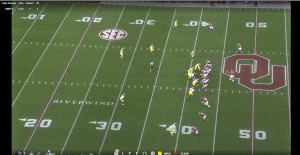
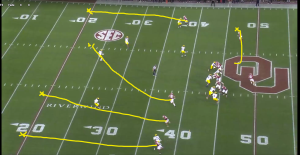
John Mateer reads the overhang through the nickel, sees the lateness, and rips the shot on a line — a throw the crew called a “Sunday” ball for its velocity and placement. That it came with a free runner pressing the pocket only underscores the processing speed: the read and release beat the pressure.
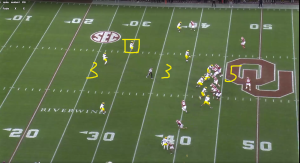
Mateer is reading the Ni who is super late to the party.
He takes his shot.
Boom.
Easy Money.
The staff is comfortable calling the concept backed up, trusting both Mateer’s arm and the perimeter speed to punish spacing mistakes.
Zooming out, the passing-concept ledger from the last two weeks looks like a coordinated test of breadth more than a narrow search for one bread-and-butter: Y-Cross four times, Stick three, Verts three, plus fade/now, spacing, mesh, and more — with run complements tight to the picture. That balance is the tell; Arbuckle isn’t chasing a single pitch so much as finding which pitches pair best with which defensive answers.
Disruptors: how OU manufactured stress before the snap
Rob’s taxonomy for offensive structure splits modern college systems into two tribes: the ultra-wide static crowd (think Baylor or Tennessee) and the disruptors — formations that pile obstacles into defensive rules with stacks, bunches, unbalanced looks, and formation-into-boundary (FIB)(think Kiffen and Sark). Arbuckle is firmly in the second camp. Against Michigan, half of OU’s snaps featured a disruptor (up from ~18% the week prior), and the film showed the full kit: motioning into stacks, empty, bunch, FIB, and condensed alignments that force coverage checks on the fly.
The practical effect is twofold. First, it hides tendencies in the run game — e.g., GY counter from multiple surfaces with quarterback involvement for a plus-one number. Second, it creates simple, high-leverage reads for Mateer in the vertical game; rotations opens clean rules: throw it now. That’s how you live comfortably in both RPO-ish grays and pure progression concepts without sounding like two different offenses.
Stat Facts: the numbers that traveled
Money downs. OU is living well on third down on both sides of the ball. Through two games, the Sooners are fourth nationally on defense (opponents 4-for-25, 16%) and seventh on offense — the kind of two-way efficiency that can paper over uneven early-season rushing outputs.
Rushing shape. The run game remains more grind than gouge — 3.75 yards per carry with only 3–4 run explosives to date, roughly 70th by explosive-run rate. But when you’re living in 3rd-and-3, the math still works; OU kept moving chains without landing the home-run cutback.
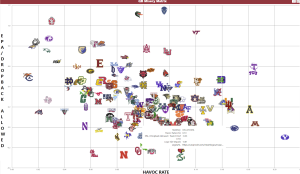
QB misery without blitz dependence. The defense’s early-season paradox is encouraging: a low havoc rate (sub-10% in Week 1; ~10% in Week 2) paired with elite negative EPA per dropback (-0.44 last week; -0.23 this week). In English: OU didn’t have to live in five- and six-man pressures to crater passing efficiency — coverage integrity and rush lane discipline were enough. That’s how you survive the SEC slate without riding the lightning every snap.
Explosive play diversity. Across two games OU charted 14 explosive plays from a wide range of sources: QB GY counter (×2), Verts (×2), Y-Cross, Mesh, GT counter, Pylon, QB inside zone, screen, Smash, Spacing, Trail, and the “cannon catch.” Variety here is the story — there’s no singular dependency defensive coordinators can lean on in scouting.
Other takeaways: special teams turbulence, OL depth, and the Mateer usage dial
Special teams almost turned a win into a lesson. OU kept Michigan inside one score for longer than necessary thanks to a cluster of miscues: a missed field goal (Sandell), a muffed punt (Aategna), running into the kicker (Omosigho), a dropped pass, and a near-miss touchdown to Jaren. Those stackups can swing tight games; the difference Saturday was OU’s resolve to ride them out rather than fray. Venables’ cultural buy-in showed when the inevitable wobble hit.
Charlie notes the ultimate eight-minute closer. If you’re looking for a grown-up drive, OU gave you one: eight minutes of fourth-quarter clock milked behind a line that, earlier in the night, struggled to sustain. No 75-yard pops here — just four, three, four, and a fresh set. That sequence matters in October. It also arrived with four new OL starters in the mix, a useful stress test that pointed toward real depth.
How much QB run is enough? Mateer gave OU a gritty, legs-first performance, but the show consensus was clear: that volume can’t be the weekly plan. Charlie expects the staff to dial back designed QB carries in a get-right spot versus Temple (think rollouts and rhythm throws), then re-open the run-heavy QB chapter if Auburn forces it. It’s game-plan, not identity.
A linebacker who announced himself. Owen Heineke turned heads as the surprise plus defender of the night — the kind of depth-chart riser you circle in September because his snap-to-snap reliability lets you stay in your call. Charlie admitted he was skeptical in August; he wasn’t after Saturday. Kobie McKenzie’s arrow, meanwhile, continues to point up.
The shape of Arbuckle’s plan (so far)
Two themes recur. First, OU is spreading the ball and the formations — the disruptor rate is high, the concept list is long, and the explosive chart reads like a sampler platter, not a single-barrel. That multiplicity keeps defensive coordinators from anchoring their week around one answer.
Second, the run game is more about control than chunk at the moment — acceptable in September if your third-down engine stays hot and your verticals punish rotation errors. The plus-one QB run (GY counter, QB IZ) is a smart situational lever; it just can’t be the whole show. We expect the RB run game to expand!
The defensive picture: quiet violence
No one will confuse OU’s first two weeks with a sack parade, and that’s kind of the point. The “QB misery matrix” pairing low havoc with brutal EPA suppression tells on the back end — coverage plaster, leverage wins, and fewer freebies in the middle of the field. Last year’s Ohio State profile lived down in this quadrant all year and the champions of the past; if OU lingers there, it means the structure is doing its job and the pass rush is finishing enough to keep the EPA floor low. Only the biggest players for a National Championship have lived here.
Huge thanks to everyone who made the tailgate special — especially all the TFBers who showed up (and brought family) and to K and Charlie for backing the party. And to everyone listening in and firing off questions, we appreciate you. This has been a blast.
If you’re enjoying this, championstandard.com is free all year.
New stuff drops on a schedule: offensive report every Tuesday, tailgate info on Wednesday, defensive report on Thursday, and advanced metrics on Friday—plus bonus pieces when the film or numbers demand it.
Believe!
Boomer Sooner!
Rob